What is the “Kotel” Law?
Near the end of February, 2026 a small but significant media storm erupted ahead of the preliminary reading of MK Avi Maoz’s (Noam) proposed amendment to the “Protection of Holy Places Law“.
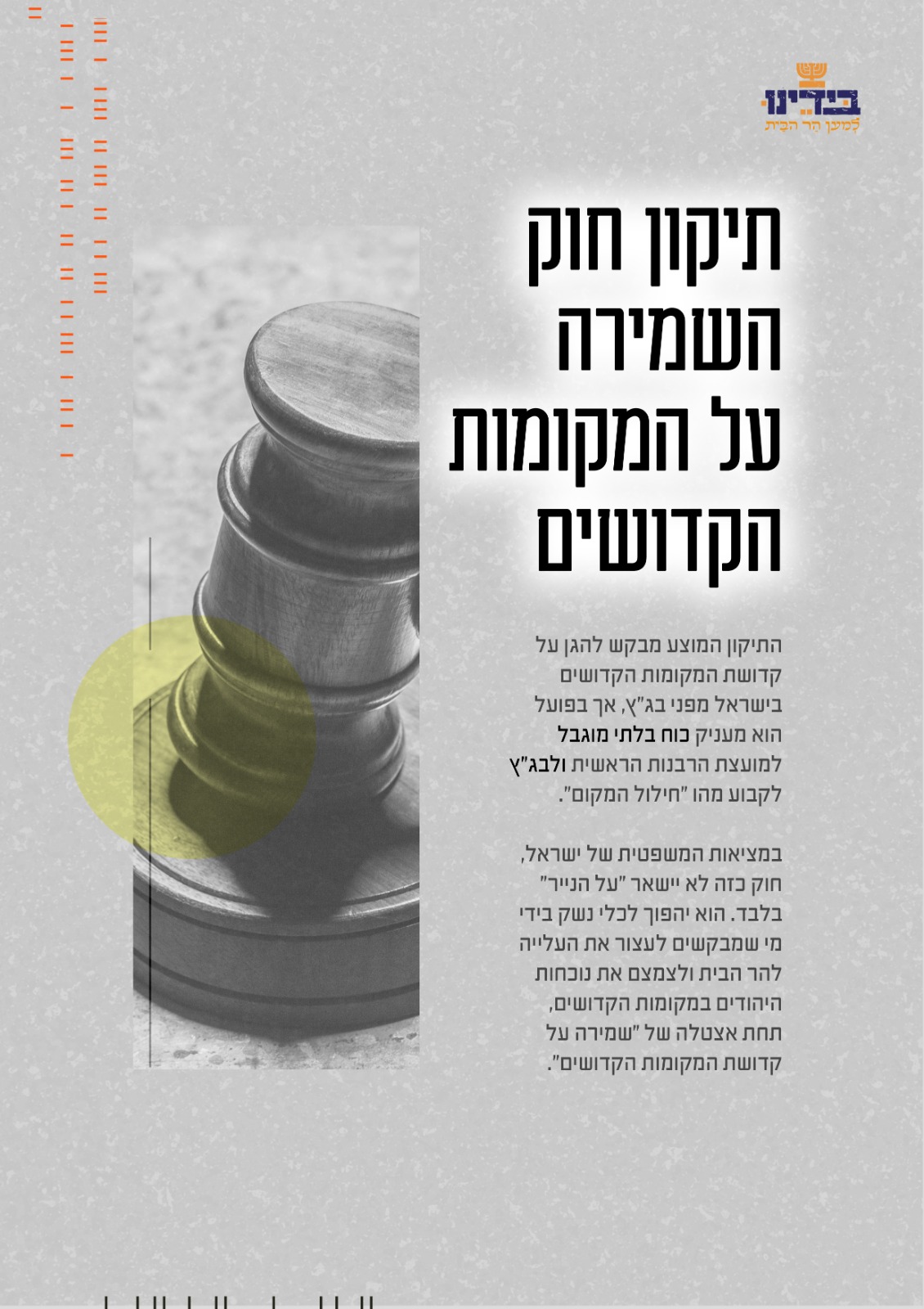
Maoz’s proposal was designed to deny the Supreme Court (High Court of Justice / Bagatz) the foothold they assumed over the years regarding rulings and new arrangements at holy sites, with particular relevance to the Western Wall after the court determined that in accordance with a cabinet decision from 2018, the government must establish a permanent mixed-gender plaza for the Reform Movement near the Southern Wall.
(Currently, there is a temporary plaza, slightly away from the Wall’s stones themselves. Under the Supreme Court’s ruling, a permanent and organized plaza would be established – like the men’s and women’s sections at the Western Wall.)
This reflects a deeper question on Jewish identity in Israel, a question that Israeli governments have ignored, and one that must be determined by the citizens of Israel through elected representatives – not by Supreme Court justices.
What are they trying to change?
Section 2(a) of the Law, states: “Whosoever desecrates or otherwise violates a Holy Place shall be liable to imprisonment for a term of seven years.”
Maoz’s proposed amendment is to define “desecrations” as
“behavior contrary to the guidelines and rulings of the Chief Rabbinate“.
This may seem like a welcome step, an attempt to stop ongoing provocations at holy sites. However, the Chief Rabbinate consistently opposes Jewish presence on the Temple Mount – evidenced by the sign posted at the entrance forbidding entry. This means according to the amendment – ascending the Temple Mount would risk 7 years imprisonment, as Jewish ascent is contradictory to the Rabbinate’s guidelines.
Why doesn’t Maoz think it will harm the Temple Mount?
Maoz, who opposes Temple Mount ascent on halachic grounds, and supporters of the amendment argue that the Temple Mount won’t be affected, since Section 4 of the Law grants the Minister of Religious Affairs the authority to decide where to implement it. Based on this in 1981, numerous regulations were enacted regarding the Western Wall, along with a list of 16 holy sites across the country. The Temple Mount was not included.
Today, on the government website for the Ministry of Religious Services, you can download a file listing 142 holy sites in Israel. Over the years, Israeli governments have consistently avoided adding the Temple Mount to this list, and it is still excluded.
The Temple Mount – the holiest site in Judaism – is, technically, not included in the list of holy sites.
The Legal Reality:
But the legal reality tells a different story: The Supreme Court ruled in 2009 (Sheikh Abdullah Nimer Darwish v. Minister of Religious Affairs) that “the list is in practice longer than the one appearing in the addendum to the regulations” (from the ruling) – effectively adding the Temple Mount, historically the uncontested holiest site in Judaism, whether we want it to or not.
Existing regulations already include: “passageways accessible from within the plaza of the Western Wall” as part of the Western Wall. This includes the entrance to the Temple Mount — located adjacent to the entrance of the Western Wall, enabling restrictions to be imposed even before ascending the Temple Mount.
This isn’t unfounded – the police already claim that entrance to the Temple Mount falls under the responsibility of the Western Wall Heritage Foundation.
Once “desecration” is defined by the Chief Rabbinate; there ruling that ascending the Temple Mount is classified as desecration will become a legal matter. From there, the path th make ascending the Mount a felony is a short one.
The Supreme Court
Another significant force that opposes Jewish presence on the Temple Mount is the Supreme Court, and while it has never explicitly ruled against Jewish ascent to the Mount, it has consistently refused petitions filed by ascenders over the years.
Today’s legal reality allows for broad interpretation, with the Court allowing itself to “play” with the wording of legislation and rule according to its own agenda. Like the Basic Law: Human Dignity and Liberty — which appeared to be a welcome piece of legislation, supported by right-wing MKs and was later morphed into something else by the court — this amendment may prove a generational mistake, with the Israeli right falling once again into a trap of its own making.
What does the law imply?
Even if we assume that Maoz’s intentions are pure, and the Law truly does not apply to the Temple Mount since it isn’t on the list of holy sites — the implications are disturbing:
Does the current government, that includes the largest number of ministers and MKs who support Jewish rights on the Temple Mount in history ,deny the Temple Mount is holy?
Will Ben Gvir or Smotrich petition the Supreme Court against the Chief Rabbinate, claiming that the Temple Mount is not on a holy site, and therefore the law shouldn’t apply?
The Temple Mount is the holiest site in Judaism!
What will the implications be for denying this basic fact?
It would be one thing if the law included a clear exemption for the Temple Mount — but it doesn’t.
The bill passed its preliminary reading, 56 in favor and 47 against, following widespread public controversy. Many coalition members chose to ignore the Temple Mount, though some stated that it should be explicitly exempted in the legislation and committed to working to that end.
Others chose to absent themselves from the vote — such as MK Dan Illouz, chairman of the Knesset caucus for Jewish freedom on the Temple Mount, who faced unfair and unjustified criticism from media outlets associated with the right.
The bill is being deliberated in the Constitution, Law and Justice Committee.
We at Beyadenu are calling on Minister of National Security Itamar Ben Gvir and the Committee Chairman MK Simcha Rothman to honor their commitments and ensure — without delay — that the law does not harm ascent to the Temple Mount. Contrary to what has been claimed, the Supreme Court already included the Mount in the list of holy sites, and we can’t allow anyone to halt the growing ascents by defining our connection to the Temple Mount as “desecration.”
Thanks to our intensive efforts, senior coalition figures committed to ensure no harm comes to those who ascend the Temple Mount.
We will continue to stand firm against any infringement on the Jewish people’s right to ascend to their holiest site – the Temple Mount.